

What we've learned by creating a new business model for Wordle
We built Wordle, with a twist... and then it became part of an open source app ecosystem

A couple of months ago we shared our thoughts on an experiment we wanted to conduct. Something we termed ‘Hyper Wordle’.
The overall goal was to take the hit game Wordle and then, using the OPENFORMAT toolkit, turn it into an ecosystem of connected Wordle apps.
In doing so we wanted to test some theories we had around how the underlying business models involved in open source applications could be improved, and the original creator of an app could benefit from others innovating on top of their creation.
Well since that last post we’ve built, we’ve tested and we’ve managed to prove some of the hypotheses we had. To test these we built two (very different) apps that form part of a mini ‘Hyper Wordle’ ecosystem.
App 1: Rewardle
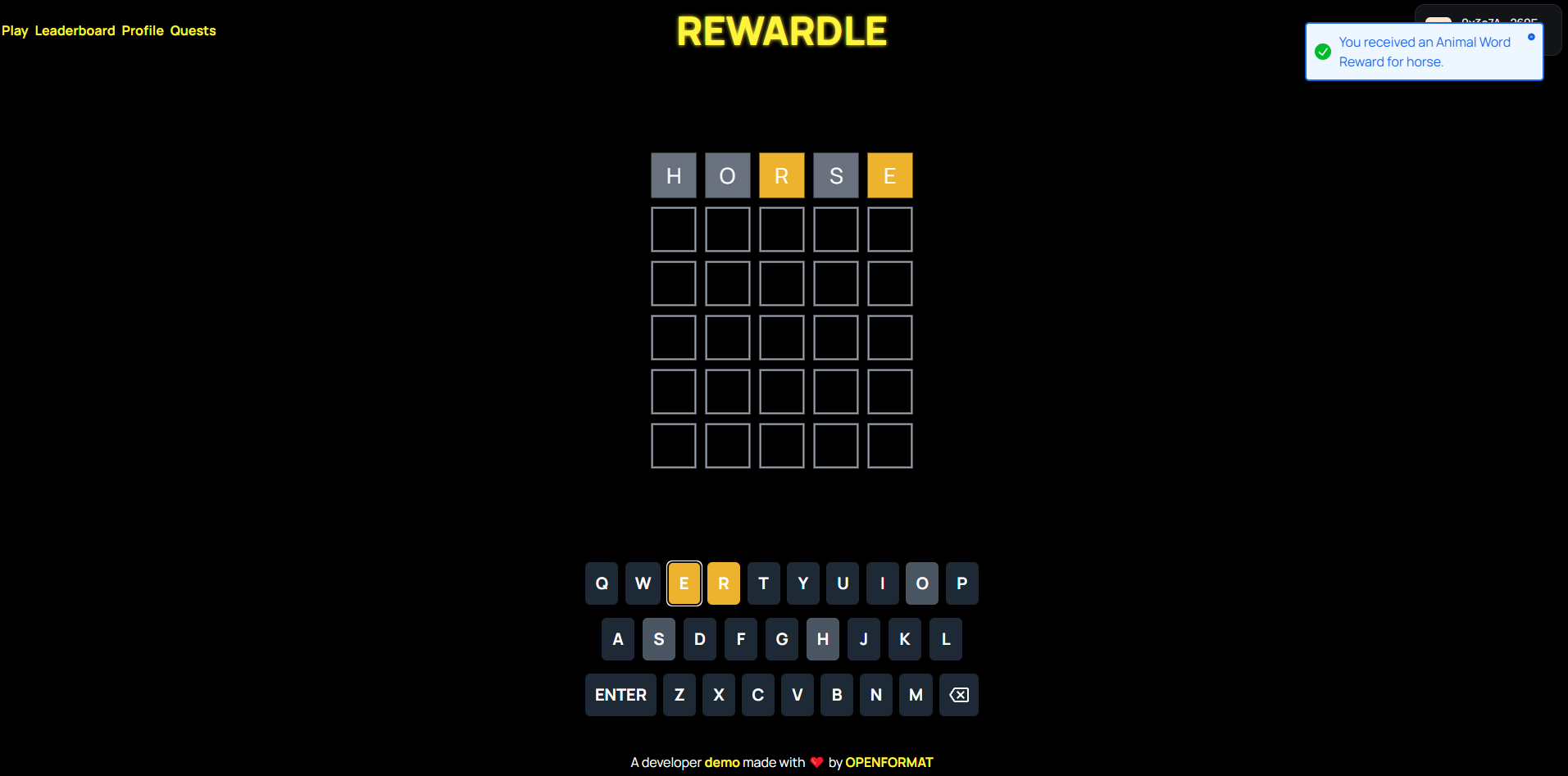
Andy, Eugene and the dev team built ‘Rewardle’, a web app built using React and the OPENFORMAT SDK. The functionality was exactly the same as Wordle (albeit with a reduced pool of words), but it introduced some additional elements:
Every time the user won (got the correct answer), or lost (ran out of attempts) they were rewarded.
They were also rewarded with badges and $REWARDLE tokens for completing collections of actions (you could call these quests or missions). These quests ranged from ‘Add a name to your profile’ to ‘Guess 10 Animals’.
If the user had completed their daily word, they could have another go, but with one caveat… they would have to pay for it with $REWARDLE tokens. These were the tokens that they had earned through quests but in future they could be able to buy these tokens.
There was a leaderboard which showed who had earned the most XP. This was earned through actions and quests and meant that the ‘top dog’ wasn’t necessarily the user who had won the most, but the user who had participated in the ways that earned them the most XP - this is actually a very significant behavioural difference.
App 2: A Quiz App
After playing Rewardle slightly too much I realised that I was the top holder of the $REWARDLE token. I could have just held on to the token, but instead I decided that I wanted to be a part of this ‘Hyper Wordle’ ecosystem and build on top of the foundations that had been created through Rewardle.
With my limited developer experience I couldn’t use React, so instead I built an app using my favourite low/no-code tech stack for building mobile apps: FlutterFlow and BuildShip. I also chose to use the OPENFORMAT API, rather than the Typescript SDK.
I built a fairly straightforward quiz app: there were different categories and different difficulties, a leaderboard and missions which you could complete to unlock the ‘extra hard’ difficulty. But most importantly you could purchase access to extra categories using the $REWARDLE token and you could earn it by completing different activities within the quiz app.
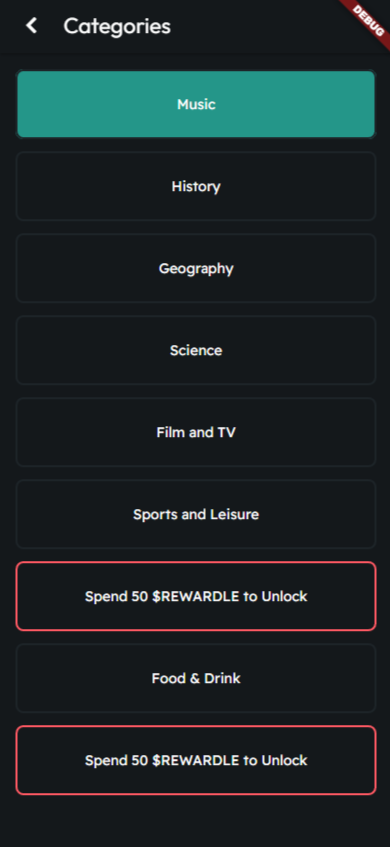
I recorded a little demo showcasing the ability to carry $REWARDLE from one app to another, it was recorded at 2:00am and was designed just to show what I did to the internal team, but it’s pretty cool so I thought I’d share it here too.
What does this show?
Well we set out to test quite a few hypotheses and what we learnt through these two test apps actually taught us quite a lot…
Hypothesis 1: Users can carry rewards from one app to another
Proven ✅
The user has complete portability when it comes to the XP, badges and $REWARDLE tokens that they earn, this means that they could earn $REWARDLE in the quiz app and then go and spend it in the Rewardle app, or that an achievement earned in Rewardle could be used to gate exclusive content in the quiz app.
The potential for additive innovation that this portability introduces is very interesting and has a lot of implications far beyond just gaming apps.
Hypothesis 2: People can build apps permissionlessly using the $REWARDLE token
Proven ✅
The fact that I could go and build an app that leveraged the token Andy (the original creator of Rewardle) had created, and that I could use this to run my tiny quiz app economy WITHOUT having to reach out to Andy or trust him in any way is a big deal.
This helps open up innovation on top of applications and could completely change the way open source projects like the original Wordle are designed.
Hypothesis 3: As people build clones or apps that use a token from another project, it benefits the original creator
Proven to Some Degree 👀
Within the current system if a user say comes to my clone, the quiz app, as they play they are earning and spending the $REWARDLE token, by doing this they aren’t going to be directly benefitting the original creator, but they will be indirectly.
In order to keep my app running I will need to have enough $REWARDLE tokens, therefore I will need to earn or buy them within the original creators app, when I do this it does benefit the original creator.
Also, just by the existence of my app it means that there is more utility for the token that the original creator has built. This means that people are more likely to want to get and use that token, Rewardle is the core way to do that.
Hypothesis 4: There is sufficient incentivisation for builders to build ‘on top of’ existing applications in this way
Not Yet Proven ❌
We have tested the more technical hypotheses but unfortunately to test the more social hypotheses we have (like this one) we need to put this model out in the open and get real users and builders using it.
Eventually we’ll be adding in the ability to ‘buy’ tokens both as part of this app but also our wider toolkit. At this point creators will be able to split revenue so that part of $REWARDLE (or their own token) transactions would always go back to them, the original creator, as people use and build on top of their systems.
We’re not quite there yet and we’re still finalising our model around this, but it’s our next step and its coming soon.
Me and Sarah sat down to discuss some of these hypotheses in more detail, you can check out that discussion here.
Thanks, Dan and the OPENFORMAT team 👋🏽